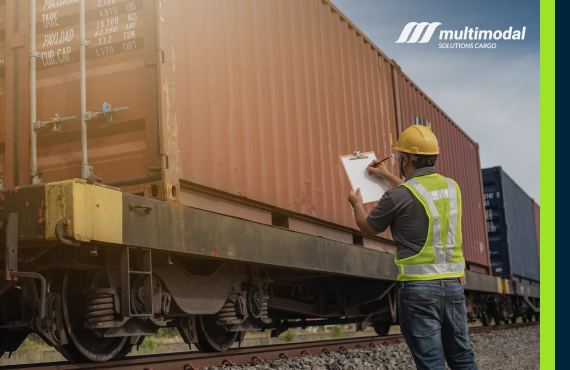

Discover how intermodal terminals work and why they are a strategic link to achieve more efficient, sustainable and adaptable supply chains. A clear explanation for logistics decision makers without getting into technicalities.
In logistics, every movement counts. It is not only about getting products from point A to point B, but also about how to do it more efficiently, with greater traceability and better coordination between modes of transport. In this scenario, intermodal terminals become a fundamental part of the logistics strategy of any company that is committed to scaling its operations intelligently.
An intermodal terminal is a specialized facility that allows containers to be transferred from one mode of transport to another, for example, from train to truck or vice versa. Most importantly, this transfer occurs without the need to open the container or handle the goods, which protects the integrity of the product and speeds up the process. The terminal functions as a hub connecting different routes, combining the strength of long-distance rail transport with the flexibility of last-mile trucking.
For companies, this represents a major operational advantage. Through the use of intermodal terminals, it is possible to improve logistics efficiency by taking advantage of the lower energy consumption of the train, reduce risks associated with handling, and ensure greater predictability in delivery times. This strengthens operational continuity and allows us to offer a more robust service to customers and distributors.
In addition, intermodal terminals also represent a solution aligned with sustainability objectives. By reducing the exclusive use of road transport and combining it with more environmentally efficient modes, the carbon footprint of logistics operations is significantly reduced. This is increasingly valuable for companies committed to ESG standards or social responsibility policies.
Another important aspect is scalability. Intermodal terminals are designed to operate with high volumes and extended schedules, allowing companies to respond with greater agility in times of high demand or expansion projects. This translates into a real competitive advantage over less adaptable supply chains.
Understanding the role of intermodal terminals is not just a matter of logistics, but of business strategy. Leveraging these hubs allows companies to integrate more efficient, sustainable and growth-ready operations. And in an increasingly competitive marketplace, having a smart supply chain can make all the difference.